Aluminium for safer trucks
Road safety and fuel efficiency are without doubt two major priorities for EU policy makers. One area where a lot can be done for the road safety is to reduce the severity of accidents between large trucks and smaller personal vehicles and vulnerable road users. Due to restrictions in the dimensions of heavy duty vehicles (EU Directive 96/53/EC), tractors are normally designed in a very compact way in order to maximise the volume of goods that can be carried.
Figure 1
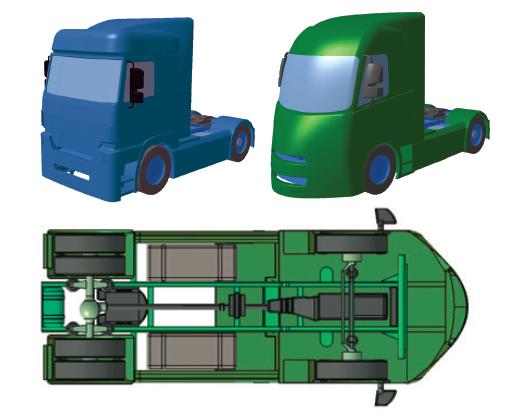
The compact design leads to a flat front which in the event of a crash with a smaller vehicle absorbs very little crash energy. A study was consequently launched to investigate if a longer tractor optimised for better aerodynamics and pedestrian safety (Figure 1) could be equipped with an energy-absorbing crash management system (CMS).
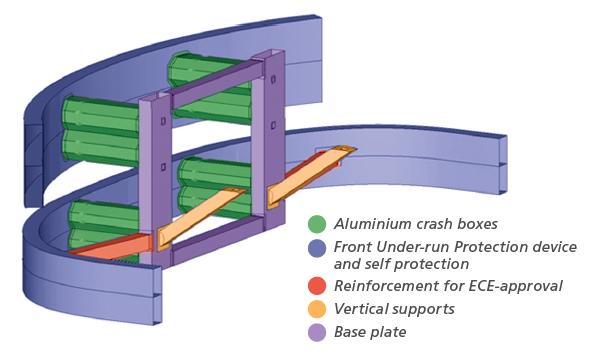
The resulting design of the CMS can be seen in Figure 2. The lower structure is an energy-absorbing Front Under-run Protection (ea-FUP), which softens the impact of the crash and prevents passenger cars from being run over by the truck. The upper structure acts mainly as protection for the truck driver.
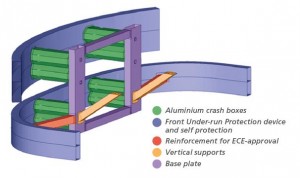
Figure 2
Advanced aluminium alloys were used due to its high specific energy absorption capacity compared to other materials. This resulted in a very modest weight increase of 10 kg compared to a CMS from a conventional tractor with a much lower energy absorption capacity. Furthermore, by designing the CMS with extruded aluminium profiles, it was possible to keep the cost of the CMS low.
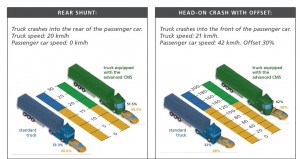
Figure 3
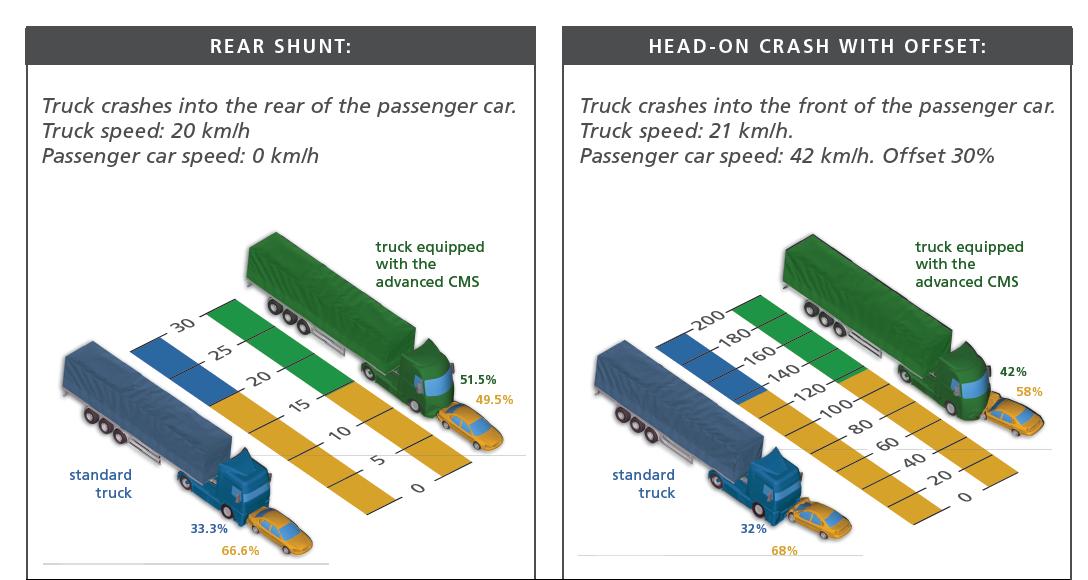
The report shows that increasing the energy absorbing capacity of the truck front structure can greatly improve its behaviour in the event of a crash (Figure 3). But the adoption of devices into the design of new trucks must not be penalized. Thus a change in the size and weight directive 96/53/EC is needed so that an improvement of the safety or the fuel efficiency does not influence the payload capacity.
The study was conducted and published by the Institut für Kraftfahrzeuge of RWTH Aachen University and was a part of a bigger study in collaboration with the NGO Transport & Environment.
More information:
- Link to leaflet
- Link to study
- [email protected]
L’aluminium contribue à la sécurité passive des véhicules industriels
La sécurité routière et l’efficacité énergétique sont sans aucun doute deux priorités majeures des constructeurs européens de véhicules industriels. Réduire la gravité des accidents entre les véhicules industriels, les automobiles et les usagers faibles, est bien un domaine où beaucoup peut encore être fait pour améliorer la sécurité routière.
Néanmoins la limitation de la longueur totale des poids lourds imposée par la Directive Européenne 96/53/EC, se répercute sur la conception des camions et des tracteurs routiers: les cabines sont très compactes afin de maximiser le volume de fret.
Figure 1
Cette compacité impose une face avant très plane aux tracteurs et camions, ce qui ne permet pas une forte absorption d’énergie de choc en cas de collision avec un autre véhicule. Une étude a donc été lancée pour déterminer si un tracteur plus long, préalablement optimisé pour une meilleure aérodynamique et plus de sécurité pour les piétons (Figure 1) pourrait être équipé d’un système de crash management (CMS).
Le système CMS résultant de l’étude est illustré par la figure 2. La partie la plus basse constitue un dispositif de protection contre l’encastrement qui absorbe de l’énergie en cas de choc frontal (“energy-absorbing Front Under-run Protection, ou “ea-FUP”) protégeant ainsi mieux les passagers de l’automobile heurtée que les protections anti-encastrement classiques. La structure supérieure agit essentiellement pour protéger le conducteur du poids lourd. Ce système est construit avec des alliages d’aluminium parce qu’ils ont une capacité spécifique d’absorption d’énergie plus performante que celle des autres matériaux.
Figure 2
Le système CMS en aluminium ne pèse que de 10 kg de plus qu’un CMS conventionnel dont la capacité d’absorption est beaucoup plus faible.
De plus, le coût du système CMS reste d’un niveau modéré grâce aux profilés en aluminium.
Figure 3
Le rapport d’étude montre que l’augmentation de la capacité d’absorption d’énergie en cas de choc frontal d’un tracteur peut grandement améliorer son comportement en cas de crash (Figure 3). Mais, l’adoption de ce système dans le design de nouveaux tracteurs ne doit pas être pénalisante. C’est pourquoi une évolution des contraintes de dimensions de la Directive Européenne 96/53 est nécessaire de sorte qu’une augmentation de la sécurité routière n’ait pas d’incidence sur le volume de chargement.
Cette étude a été menée – et ses résultats publiés - par l’Institut für Kraftfahrzeuge de l’Université RWTH de Aix-la-Chapelle.
Pour plus d’informations:
- Lien vers dépliant
- Lien vers l’étude
- [email protected]
Aluminium für sichere LKW
Verkehrssicherheit und Kraftstoffeffizienz sind zweifelsohne zwei der wichtigsten Prioritäten der EU- Entscheidungsträger. Ein Bereich, in dem sehr viel für die Verkehrssicherheit getan werden kann, ist die Reduzierung der Auswirkung schwerer Unfälle zwischen großen Nutzfahrzeugen und kleineren Personenkraftwagen oder ungeschützten Straßenverkehrsteilnehmern. Durch die Begrenzung der Gesamtabmessung von schweren LKW (EU Direktive 96/53/EC) sind die Zugmaschinen normalerweise sehr kompakt gebaut, um möglichst viel Volumen für die Ladung zu bieten.
Bild 1
Dieses kompakte Design führt zu einer flachen Front, die im Falle einer Kollision mit einem kleineren Fahrzeug nur sehr wenig Energie absorbiert. Eine neue Studie wurde hierzu ins Leben gerufen, um zu untersuchen, ob eine längere Zugmaschine mit optimierter Aerodynamik und verbessertem Fußgängerschutz (Bild 1) mit einem energie- absorbierenden Crash- Managementsystem ausgestattet werden kann.
Das hieraus resultierende Design des Crash- Management- Systems (CMS) ist in Bild 2 zu sehen. Die untere Struktur ist ein energie- absorbierender Unterfahrschutz, der die Folgen des Aufpralls abschwächt und verhindert, dass PKW von dem LKW überrollt werden. Die obere Struktur fungiert hauptsächlich als Schutz für den LKW- Fahrer.
Bild 2
Für diese Studie wurden moderne Aluminiumlegierungen aufgrund ihres hohen spezifischen Energieabsorptionsvermögens im Vergleich zu anderen Werkstoffen ausgewählt. Dieses führte zu einem sehr moderaten Anstieg des Gewichtes von 10 kg im Vergleich zu einem CMS einer konventionellen Zugmaschine mit einem deutlich geringeren Energieabsorptionsvermögen. Zudem ist es durch die Verwendung von Strangpressprofilen möglich, die Kosten des CMS gering zu halten.
Bild 3
Die Untersuchungsergebnisse zeigen auf, dass die Steigerung des Energieabsorptions-vermögens einer LKW- Fahrzeugfront ganz wesentlich das Verhalten im Fall einer Kollision verbessern kann (Bild 3).
Die Änderung dieser vorderen Fahrzeugstrukturen darf aber nicht zu Lasten der Wirtschaftlichkeit gehen. Eine Anpassung der Größen- und Gewichtsdirektive 96/53/EC ist daher dringend notwendig, damit eine Verbesserung der Sicherheit und der Kraftstoffeffizienz nicht zu einer Einschränkung der Nutzlast führt.
Die Studie wurde vom Institut für Kraftfahrzeuge der RWTH Aachen durchgeführt und veröffentlicht.
Weitere Informationen unter:
- Link zur Broschüre
- Link zur Studie
- [email protected]
Alluminio per autocarri più sicuri
La sicurezza stradale e l’efficienza energetica sono senza dubbio due delle maggiori priorità per il legislatore europeo. Un’area in cui si può fare molto per la sicurezza stradale è di ridurre la gravità degli incidenti tra veicoli pesanti e leggeri o utenti vulnerabili. Per via delle restrizioni nelle dimensioni dei veicoli destinati al trasporto pesante (Direttiva EU 96/53/EC), le motrici sono normalmente progettate in modo molto compatto, al fine di massimizzare il volume della merce che può essere trasportata.
Figura 1
Il design compatto porta ad un muso piatto il quale in caso di collisione con un veicolo più piccolo assorbe pochissima energia d’urto. Di conseguenza è stato promosso uno studio per analizzare se una motrice più lunga ottimizzata per una migliore aerodinamica e sicurezza dei pedoni (Figura 1) poteva essere dotata di un sistema di crash-management (CMS) che assorbisse energia.
Il design del CMS che ne è risultato é illustrato nella Figura 2. La struttura inferiore è una Protezione Sotto-corsa Frontale che assorbe energia (energy-absorbing Front Under-run Protection o ea-FUP), che attutisce l’impatto della collisione ed evita alle autovetture di venire travolte dall’autocarro. La struttura superiore funge principalmente da protezione per l’autista del camion.
Figura 2
Sono state utilizzate le più evolute leghe di alluminio per via della loro elevata specifica capacità di assorbire energia rispetto ad altri materiali. Questo si traduce in un modestissimo incremento di peso di 10 kg rispetto ad un CMS di una motrice convenzionale con una capacità di assorbimento dell’energia di gran lunga inferiore. Inoltre, progettando i CMS con profili di alluminio estruso, è stato possibile mantenere basso il costo del CMS.
Figura 3
Il rapporto mostra come, incrementando la capacità di assorbimento dell’energia della struttura anteriore di un autocarro, si può migliorare di molto le sue prestazioni nella capacità di assorbimento dell’energia in caso di collisione (Figura 3). Tuttavia l’adozione di dispositivi nel design di nuovi autocarri non dev’essere penalizzata. Perciò è necessario un cambiamento della direttiva 96/53/EC sulla dimensione e il peso, in modo tale che un miglioramento nella sicurezza ed efficienza del combustibile non influenzi la capacità del carico utile.
Lo studio è stato condotto e pubblicato dall’Istituto per Autoveicoli (Institut für Kraftfahrzeuge) dell’Università RWTH di Aachen.
Per maggiori informazioni:
- Link al volantino
- Link allo studio
- [email protected]