



Aluminium is a metal used in a variety of applications covering most areas of everyday life. The most important applications are covered under specific sections of this website. Aluminium is mainly used in the automotive and mass transport (Aircraft and space vehicles, rail and road vehicles, boats) for its lightweighting and energy saving properties, in building (facades, roofs, ceilings, windows, doors) because it is a long-lasting, aesthetic, functional and anti-corrosion material, and in packaging (Foil, capsules, tubes, bottles, laminates) because it is neutral tasting, practical and sustainable.
The following is a non-exhaustive overview of other applications.
 |
Mechanical engineering and precision mechanics Many industrial machinery manufacturers choose aluminium because of its advanced products and solutions and simply because its design flexibility, its easyness to machine, and its low density offers particular advantages in many applications. Applications: cylinder blocks and heads, pistons, bearings connecting rods, pulleys, hand wheels, guide rails, optical equipment, pneumatic cylinders, measuring and office instruments. |

|
Electrical & heat transfer engineering The use of aluminium in electrical and thermal applications is due to the good electrical and thermal conductivities of the alloys mainly from the 1xxx (for electrical) and 3xxx, 5xxx and 6xxx series (for thermal), but again its light weight, favourable strength-to-weight ratio and a durable corrosion resistance are added benefits compared to other materials. Almost all electric lights, motors, appliances and power systems depend on a vast grid of aluminium wire. Around the world most high-voltage overhead transmission and distribution lines and many underground lines are made of aluminium. Aluminium replaced copper in high-voltage transmission lines after 1945 and today is the most economical way to transmit electric power. |
Applications: overhead cables and accessories, ladders and cable sheathing, busbars, windings, cooling fins, heat exchangers, bond wire, antennae, condensers, casings.
 |
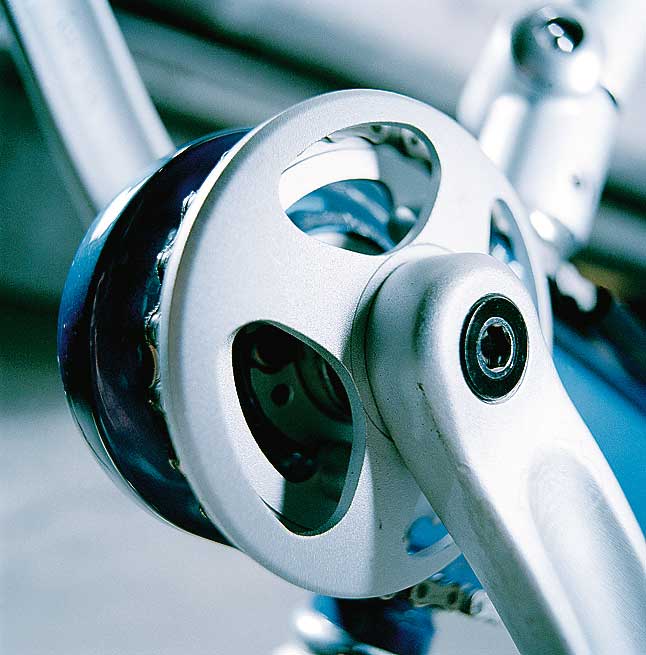
Design, Household ware and Leisure The use of aluminium in design, domestic and office applications is often due to the highly decorative and fashionable design appearance of aluminium, for example in kitchens, aluminium sheets above stoves or around ovens or the use of design aluminium handles on doors. Of course for actual furniture, such as tables and chairs, the mechanical properties are also very important. For household appliances such as irons and cooking utensils, the thermal properties are equally determining; for cooking tools, high thermal conductivity is a prerequisite additional to the lighter weight compared to copper or steel pots and pans. For lighting applications, it is the high inherent reflectivity of aluminium which determines its use, in addition to its low density. |
Applications: Furniture, utensils and decorations, climbing hooks, cycles, camping equipment, furniture design, pots, pans, cutlery, lamps, picture frames or handles for cupboards, jewellery, badges, coins.
Others
The material is used for powders and as a pigment for different paints and plastics, aluminothermic applications and sintered performs. Also, aluminium granulates are used for deoxidation of steel and pellets as filler for plastics, catalyst for the chemical industry, other special products.