



|
How the EU can stop investment leakage and help the low-carbon economy
Why is this happening?
What our industry needs:
The European Commission acknowledged the aluminium sector as “critical for the EU’s industrial value chain and urgently requires new investment to be made in the face of strong international competition” in its 2012 Communication on the EU Industrial policy. The Centre for European Policy Studies (CEPS) – a renown Brussels based research institute – was asked by the European Commission to complete a study to assess the cumulative cost impact borne by the industry and attributable to EU policies. The study provides evidence that EU climate and energy policies have a strong impact on our industry’s cost-competitiveness. Please find here the European Commission’s Cumulative Cost Assessment of the impact of EU policies on the Aluminium Industry For more information:
Manufacturing industries remain an essential foundation of the economy: Apart from providing a substantial part of Europe’s employment and economic output, manufacturing industries are also at the roots of the infrastructure and equipment through which knowledge is developed and transferred, services are invented and provided. In a nutshell, industry supplies the essential hardware on which the whole software of the digital economy operates. Despite the economic outlook, the aluminium industry in Europe is reaffirming its support to enhanced sustainability commitments and resource efficient solutions: The European aluminium industry has been a pioneer in developing Sustainable Development Indicators (SDIs), with the clear objective of sharing transparently with all the stakeholders qualitative and quantitative information based on the three pillars of sustainability, i.e. economic, social and environmental, as well as the use- and end-of-life recycling phases. The recent update of SDIs published in November 2013 shows that the aluminium industry in Europe has continuously improved its performance in key areas such as GHG emissions, worker safety and training, and recycling rates among others. The 2012 key Facts and indicators as well as the full data set are available here. |
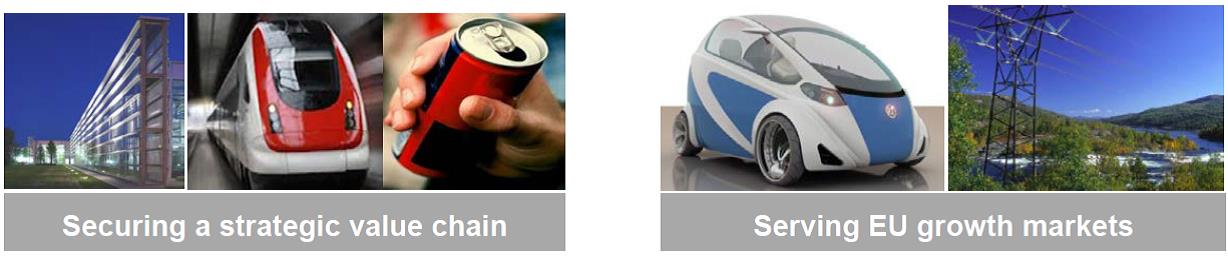


Even in the digital age and in the era of knowledge and services, manufacturing industries remain an essential foundation of the economy.
Apart from providing a substantial part of Europe’s employment and economic output, manufacturing industries are also at the roots of the infrastructure and equipment through which knowledge is developed and transferred, services are invented and provided. In a nutshell, industry supplies the essential hardware on which the whole software of the digital economy operates.
 Europe’s industry is in fierce competition with every other region of the world. Therefore the competitiveness of European industries can only be measured against the benchmark set by their global competitors. In particular, for globally traded commodities such as aluminium, the primacy and even the survival of the European industry will depend on whether or not European producers will have access to resources (raw materials, energy, workforce, capitals) and markets (domestic and foreign) at conditions comparable to those of their international counterparts. Europe’s industry is in fierce competition with every other region of the world. Therefore the competitiveness of European industries can only be measured against the benchmark set by their global competitors. In particular, for globally traded commodities such as aluminium, the primacy and even the survival of the European industry will depend on whether or not European producers will have access to resources (raw materials, energy, workforce, capitals) and markets (domestic and foreign) at conditions comparable to those of their international counterparts.Any policy or measures taken by the EU and / or its Member States jeopardizing this access on a level playing field is a direct threat to the survival and integrity of Europe’s industrial base.This in turn would threaten Europe’s ability to further invest in the development and innovation of its base industries and their downstream products, thus running the risk that the whole continent could become a regional follower instead of a world leader of global trends.The Commission’s Europe 2020 Strategy acknowledges for the first time the need for a fresh approach to Industrial Policy by presenting it as a flagship initiative. EAA welcomes the recent commitment by the European institutions to develop a comprehensive industrial policy fully integrated with other key policies such as Energy, Environment and Trade. The aluminium industry is confident that the new EU industrial policy currently under development – “An Industrial Policy for the Globalisation Era – Putting Competitiveness and Sustainability at Centre Stage” – if implemented in a coordinated and effective way, will facilitate the recovery of its competitiveness and allow the European industry to be “connected and greener”, compete effectively and successfully face global challenges. |

High energy prices and decreased availability of some alloying elements and scrap are putting strong pressure on our sector. The deteriorating cost position of the European primary aluminium industry and the increasing reliance on imported metal is leading to the progressive migration of the European aluminium industry to other regions of the world. As widely known, the price for aluminium, as for other non-ferrous metals, is determined globally on the London Metal Exchange (LME). On the other hand, the structure of the production costs for aluminium is mostly local with the exception of raw materials, whose price is usually determined with a reference to the LME prices.