Share :

Aluminium in the recycling loop

Preparation and treatment
The scraps recovered are treated according to their quality and characteristics. Common treatment processes are for example sorting, cutting, baling or shredding. Turnings are dried and crushed. Free iron is removed by magnetic separators. Aluminium skimmings, a mixture of aluminium metal and aluminium oxide, are crushed or ground and air separated.

Charging
As a rule computer controlled selection and mixing of scrap types whose chemical composition is as close as possible to that of the required alloy.

Melting
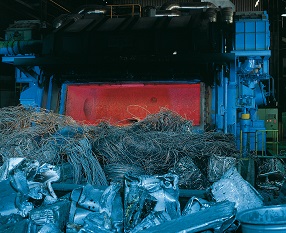
Various furnace types are available for melting aluminium scrap. In Germany, scrap for the production of casting alloys is commonly melted in rotary furnaces under a layer of liquid melting salt (flux). Producers of wrought alloys prefer open hearth furnaces in varying designs.

Scrap melting furnace Refining
The alloy production in rotary furnaces is followed by a refining process. The molten alloy is fed into a holding furnace (converter) and purified through the addition of refining agents.Quality control
Every single charge of the furnace is tested in the plants’ laboratories with modern computer controlled analytical technology equipment and, provided that the result is positive, receives a certificate.

Casting
The molten aluminium is either cast into ingots or transported in liquid form to a foundry. The ingots weigh, depending on the shape of the mould used, between 4 and 25 kg. Liquid aluminium is filled into pre-heated thermos containers and transported to the foundries, where the liquid metal is filled into holding furnaces and processed immediately.

Homogenising
Heat treatment of extrusion billets in special furnaces in order to obtain a metal structure which is appropriate for further processing and to remove residual stress of the casting.